

LED Lighting Certification Requirements in USA, EU, South Korea
LED lighting certification serves as a critical gateway for manufacturers seeking access to major global markets. Understanding regulatory requirements across different regions determines market entry success and product competitiveness. Three regions dominating global LED demand have their unique LED lighting certification requirements that manufacturers must navigate strategically. The United States has safety and energy efficiency standards, the European Union requires integrated sustainability requirements, while South Korea demands mandatory safety certification. The following comprehensive guide provides manufacturers with essential information about certification standards in the three markets, enabling informed decisions for global expansion and compliance planning.
U.S. Standards: Safety, EMC, Energy Efficiency
The U.S. LED lighting certification landscape addresses three core requirements: safety certification through NRTL-approved laboratories, electromagnetic compatibility compliance, and voluntary energy efficiency programs that drive commercial market acceptance.
Safety Certification: UL and ETL
Safety certification is mandatory for commercial LED products. UL (Underwriters Laboratories) and ETL (Edison Testing Laboratories - Intertek) serve as OSHA-recognized Nationally Recognized Testing Laboratories. Both certify products to identical safety standards. Building codes require NRTL listing for installation approvals.
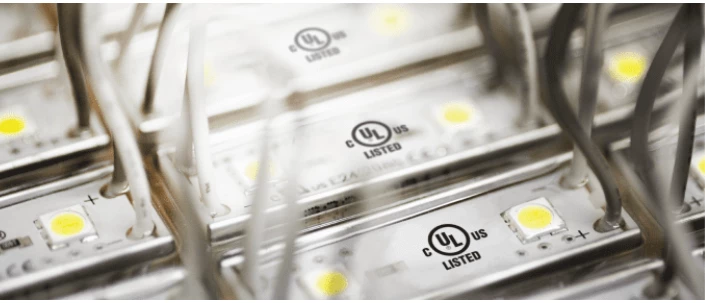
UL and ETL safety certification marks are mandatory for LED lighting products in the U.S. market.
Key standards include UL 8750 for LED equipment, UL 1598 for luminaires, and UL 153 for portable fixtures. Products receive either UL Listed status for complete items or UL Recognized status for components requiring integration.
ETL offers equivalent certification at lower cost and faster processing times while maintaining the same regulatory acceptance.
FCC Part 15: Electromagnetic Compatibility
All LED lighting sold in the United States must comply with FCC Part 15 regulations for electromagnetic interference. Products are classified as Class A for commercial use or Class B for residential applications, with Class B facing stricter emission limits.
Compliance is achieved through Supplier's Declaration of Conformity with test reports from accredited laboratories.
DLC Listing: Commercial Market Qualification
The DesignLights Consortium (DLC) program qualifies LED products for utility rebates and commercial project specifications.
While voluntary, DLC listing is essential for commercial market access. The current DLC SSL V6.0 standard, effective January 2026, requires increased efficacy levels averaging 14 percent higher than previous versions. Products must meet minimum lumens per watt thresholds, typically ranging from 90-130 lm/W depending on application type.
California Title 20 and Title 24
California maintains state-specific requirements including Title 20 product efficiency standards with minimum 45 lm/W and mandatory registration in the CEC Appliance Efficiency Database. JA8 standards for residential applications require high color rendering (CRI ≥90), appropriate color temperatures (2700K-4000K), and dimming capability.
EU market: CE Marking and Sustainability Framework
The EU's LED lighting certification requirements integrate safety, electromagnetic compatibility, hazardous substance restrictions and energy efficiency into a unified framework under CE marking. Manufacturers self-declare compliance but must maintain comprehensive technical documentation.
CE Marking Requirements
CE marking for LED lighting demonstrates compliance with multiple EU directives simultaneously.
The Low Voltage Directive (LVD) 2014/35/EU covers electrical safety for products operating at 50-1000V AC.
The EMC Directive 2014/30/EU ensures electromagnetic compatibility.
RoHS Directive 2011/65/EU restricts hazardous substances, while Ecodesign Regulation (EU) 2019/2020 sets minimum energy efficiency requirements.
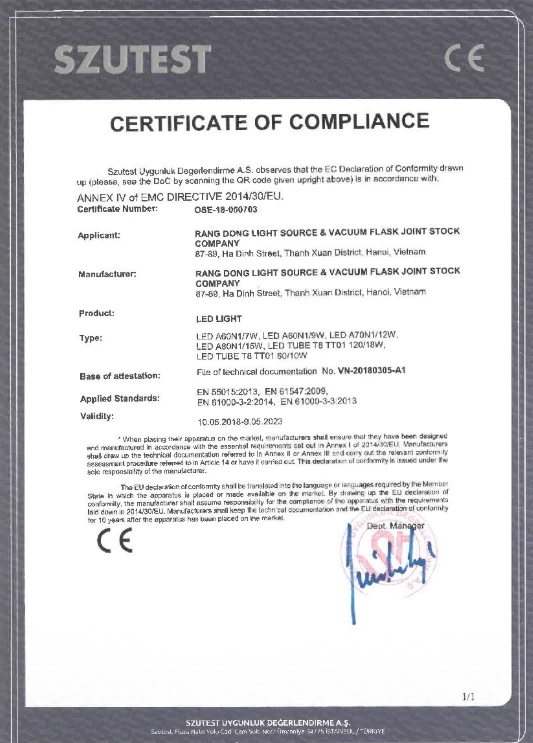
CE marking demonstrates compliance with EU safety, EMC, RoHS and energy efficiency requirements for LED products.
Manufacturers must compile a Technical File including design documentation, risk assessments, and test reports to harmonized standards. The Declaration of Conformity identifies the manufacturer and lists applicable directives. Documentation must be retained for 10 years after market placement.
Non-EU manufacturers require an EU Authorized Representative.
RoHS and REACH Compliance
RoHS restricts 10 hazardous substances including lead, mercury, cadmium and specific phthalates at maximum concentrations of 0.01-0.1 percent. LED products are inherently RoHS-friendly as mercury-free alternatives to fluorescent technologies. REACH regulations require monitoring the SVHC Candidate List (247 substances as of January 2025) and reporting substances exceeding 0.1 percent concentration to ECHA's SCIP database.
Ecodesign Energy Efficiency Standards
Commission Regulation (EU) 2019/2020 establishes minimum efficacy thresholds typically ranging from 85-110 lm/W depending on product type.
Requirements include maximum power consumption limits, stroboscopic effect measures (SVM ≤0.9), power factor requirements, and minimum 20,000-hour rated lifetime. Products must be registered in the EPREL database with QR codes linking to performance data before market placement.
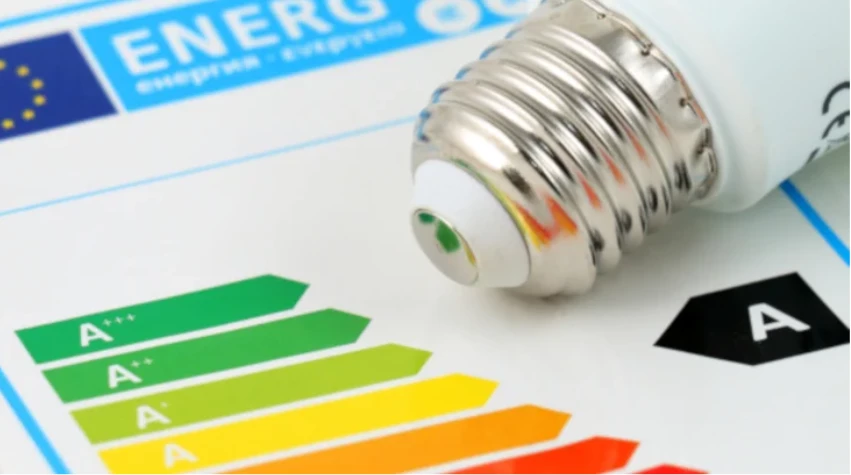
Accredited laboratory testing ensures LED lighting products meet international safety and performance standards.
The upcoming Ecodesign for Sustainable Products Regulation (ESPR) will expand requirements to include circular economy aspects, repairability scores, and digital product passports.
South Korea
South Korea's LED lighting certification system centers on mandatory KC (Korea Certification) marks regulated by the Korean Agency for Technology and Standards. The KC system consolidates product safety and energy efficiency requirements into a unified framework.
KC Certification Structure
Korea operates three tiers of KC certification.
Type 1 Safety Certification is the most stringent, requiring product testing, factory audits, and annual follow-up inspections. LED lighting products typically fall under Type 1 requirements.
Type 2 Safety Confirmation involves product testing by accredited organizations without factory audits.
Type 3 allows Supplier Declaration of Conformity through self-inspection.
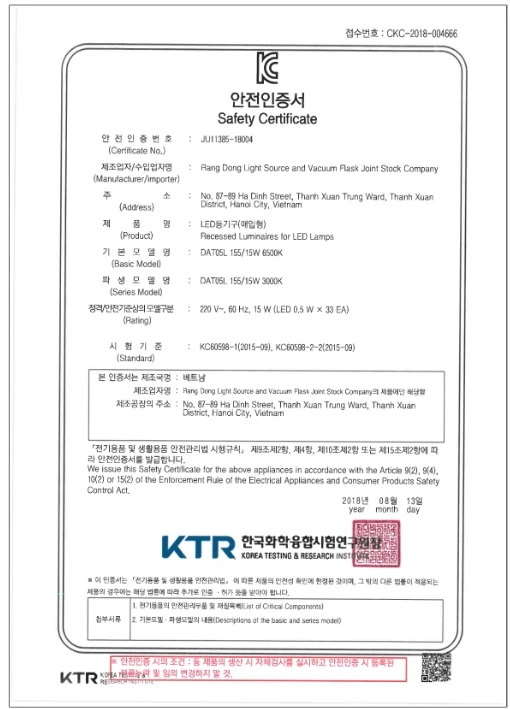
KC certification mark is mandatory for LED lighting products sold in the South Korean market.
Type 1 certification involves testing to Korean K standards including K 60598 for luminaires and K 61347 for lamp control gear. Testing covers electrical safety, optical performance, thermal characteristics, and electromagnetic compatibility. Factory inspections evaluate manufacturing facilities, quality control systems, and production consistency.
The certification process typically requires 3-5 months including testing and factory inspection coordination.
Critical for international manufacturers: Only manufacturers can apply directly for KC certification.
Non-South Korean traders cannot obtain KC approval. A South Korean representative is mandatory for foreign manufacturers to handle communications with KATS and coordinate compliance activities.
Energy Efficiency Requirements
South Korea's Minimum Energy Performance Standards (MEPS) assigns products energy efficiency grades from 1 (highest) to 5 (minimum acceptable). Products below Grade 5 are banned from production and sale in Korea, with penalties up to 20 million KRW for non-compliance.
Mandatory energy efficiency testing and grade labeling on products and packaging are required, with registration in the Korea Energy Management Corporation database.
Technical Considerations
South Korea operates on a 220V AC/60 Hz power system. Products must be specifically designed and tested for Korean electrical parameters. All documentation including technical files, test reports, user manuals, and packaging labels must be submitted in Korean.
Using CB Scheme certificates with Korean voltage specifications can significantly shorten KC approval timelines.
LED lighting certification across the U.S., EU, and South Korea markets represents essential requirements for manufacturers seeking global market access. Each region maintains distinct certification frameworks.
Successful manufacturers approach LED lighting certification strategically by understanding mandatory versus voluntary requirements, planning certification timelines during product development, and leveraging international standards like the CB Scheme to streamline multi-market access.
Building compliance into product design from the start, maintaining relationships with accredited testing laboratories, and staying current with regulatory updates ensures efficient market entry and sustained competitiveness in the global LED lighting industry.
Should you have any questions or request a quotation of Rang Dong products, please send us an email to: export@rangdong.com.vn
Websites: en.rangdong.com.vn and vacuumflask.rangdong.com.vn.