


Smart Road Lighting System Offers Far More Beyond Brightness
Highways, expressways and city streets need more from a road lighting system than just simple lighting. A quality system has to satisfy technical standards, support nighttime traffic safety, run efficiently over long operating hours and stay ready to connect with the smart infrastructure many cities are building today. Rang Dong, Vietnam's leading manufacturer of LED smart product, works with investors and contractors across these exact requirements on road and highway projects. This article looks at the core criteria that separate a genuinely effective road lighting system from one that only checks the box of having enough fixtures installed.
A road lighting system that looks bright is not automatically a system that performs well, since output alone says little about how that light is distributed across the road surface.
High-wattage fixtures and standards-compliant fixtures are not the same thing; what matters is whether light lands accurately on the road surface and suits how a specific route is actually used.
Road type, traffic speed, pole spacing and mounting position all factor into whether a system genuinely performs.
Standards and nighttime safety
A compliant road lighting system starts from recognized lighting standards, the kind built around the same luminance and uniformity principles found in international frameworks such as the IEC 60598 luminaire series.
Typical road lighting requirements call for a minimum average road-surface luminance around 2 cd/sq. m. and an overall luminance uniformity of about 0.4, figures calculated and simulated for each specific route rather than applied as a blanket number.
Meeting these figures directly supports nighttime safety, since evenly distributed light with limited glare helps drivers read the road's direction and shape, spot obstacles and other vehicles, and see pedestrians or intersections in time to react.
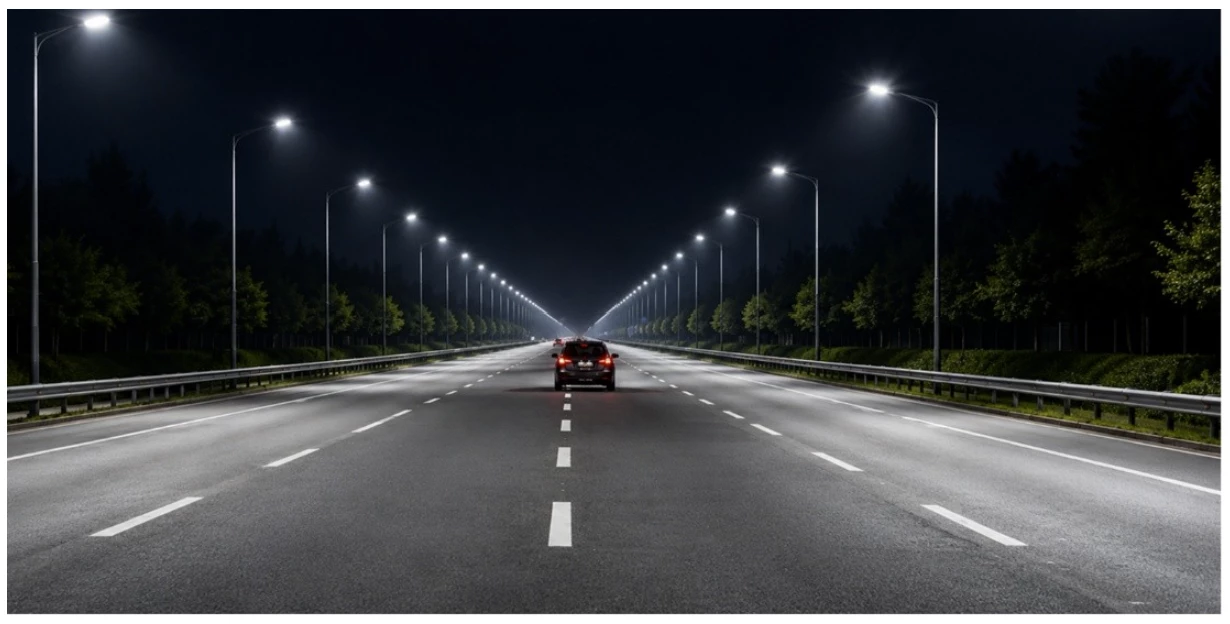 Even, glare-controlled lighting helps drivers spot obstacles, signage and pedestrians in time to react.
The right question for a road lighting system is not whether a road looks brighter, but whether light is distributed correctly, sufficiently and appropriately for that road's traffic conditions.
Efficiency, lifecycle cost
As a road lighting system typically runs for many hours a night across kilometers of road, energy efficiency has an outsized effect on total operating cost.
High-efficiency LED fixtures paired with efficient drivers cut electricity use compared with older lighting technologies, and Rang Dong's own road lighting fixtures reach a luminous efficacy of 150 lm/W or higher with driver efficiency above 94 percent.
Smart dimming and scheduling add a further layer of savings, adjusting brightness by time of day and traffic conditions instead of running every fixture at full power throughout the night.
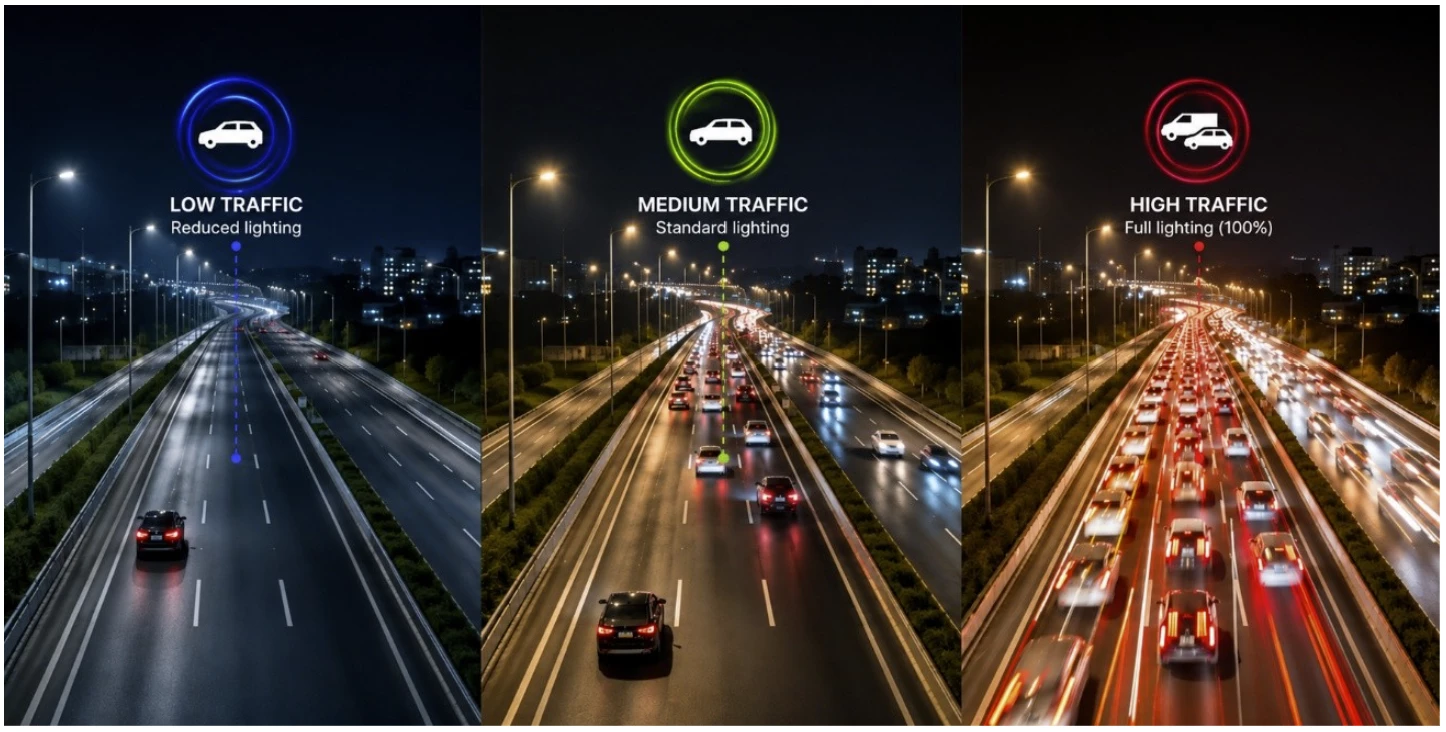 Smart dimming adjusts brightness by time of day instead of running every fixture at full power.
Purchase price alone is not the full cost picture either; project owners increasingly evaluate a road lighting system on total cost of ownership, covering electricity, inspection labor, maintenance, repairs, replacement and future upgrades across the life of the installation, since durable fixtures that need fewer replacements cut maintenance trips and downtime across a long route.
Readiness for smart infrastructure
Road lighting systems generally progress through three levels of maturity: basic on/off LED lighting, controlled lighting with dimming and scheduling, and fully smart lighting connected to Internet of Things (IoT) platforms for remote monitoring and data collection.
A smart-ready road lighting system lets managers monitor fixture status remotely, control individual fixtures or groups, schedule operation and detect faults without physically inspecting every pole.
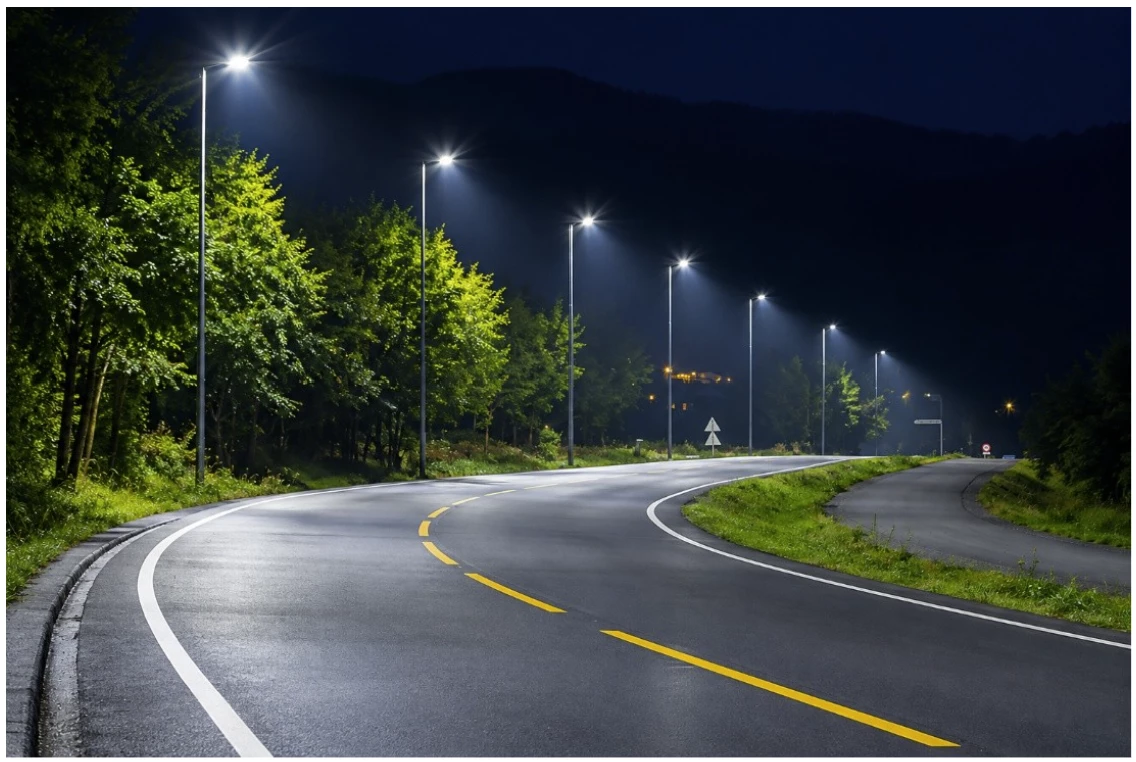 A smart-ready road lighting system lets managers monitor and control fixtures remotely.
Since connected lighting can serve as a distributed IoT touchpoint across a city, a road lighting system built with smart-ready sockets or connection points lets project owners add intelligent controllers in phases rather than committing to full smart infrastructure on day one.
Rang Dong supports this progression end-to-end, covering survey, consulting, design, simulation, supply, deployment, control and operation for road and highway lighting projects across Vietnam.
A road lighting system that meets recognized standards, supports nighttime safety, runs efficiently and stays ready for smart infrastructure delivers far more value than one chosen on brightness or price alone.
Should you have any questions or request a quotation of Rang Dong products, please send us an email to: export@rangdong.com.vn
Websites: en.rangdong.com.vn and vacuumflask.rangdong.com.vn